 |
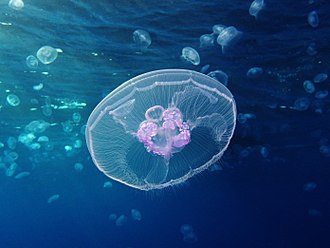
| Moon Jellyfish - an Aurelia species. Although I had never seen these before, they are apparently common in other parts of the world too. Those in the picture were photographed at the Red Sea, my cousin said she had encountered them in Italy |
-Alexander Vasenin, CC BY-SA 3.0, via Wikimedia Commons

There must be a Jellyfish Convention going on in Tasmania. On the news a few nights ago there were warnings about "Blue Bottles" – Portuguese Man - O’ -War jellyfish, along the coast, especially in the north of the state. The next day was rather hot so I went to my favourite swimming spot, looked around and seeing no Blue Bottles, I jumped straight in. The weather was perfect, the sea was calm, but suddenly I found myself surrounded by jellyfish, though thankfully not Blue Bottles.
These were what the locals call Moon Jellyfish an Aurelia species which are not supposed to be harmful, though some people may be allergic and they do have some cousins which aren’t so nice.
What was weird was the sensation. They looked like gossamer umbrellas about 6” across with pink or dark red spots in the centre and had no tendrils. ChatGPT informed me very helpfully that the pink or red bits were their reproductive organs, but instead of being filmy and delicate as I expected, they were like solid rubbery cushions which kept brushing past me or had me bumping into them. Indeed, it seemed that they were pulsing very purposefully towards me. I couldn’t get out of the water fast enough. Since then I have been learning a lot about jellyfish.
I lived in that area for more than seven years, but never saw such an abundance of jellyfish. I asked ChatGPT if this was due to climate change, but it says such blooms have more to do with the weather conditions we’ve been having lately – a lot of rain washing nutrients down into the bay, followed by some very hot days and then calm warm weather. Apparently this is perfect weather for phytoplankton development which feeds the zooplankton which in turn happens to be the Moon Jellyfish’s favourite food, thus leading to the explosion of jellyfish which I saw.
As to the feeling that they were deliberately heading my way, it's more likely that they were being partially carried by a gentle current which was driving them towards the shore, helped along by their own efforts. If you do encounter this type of jellyfish, don't deliberately handle them and if you do get stung, just rinse with seawater and you should be fine.
“Blue Bottles”
The trailing tentacles of ”Blue Bottles” can deliver a very painful sting, but are generally not fatal to healthy adults. Even dead ones can still sting, so don't pick them up if you find one on the beach.
They are not in fact true jellyfish. True jellyfish are a single organism like our Moon Jellyfish with central organs, whereas the Portuguese Man -O’ -War belongs to the order Siphonophorae which means a collection of separate organisms working together and each group having a specialised task such as reproduction, digestion, catching prey or maintaining bouyancy. Collectively they can be among the largest creatures in the ocean. They exist in many temperate waters around the world and were responsible for beach beach closures in many parts of North America in 2024. Learn more about them here
 |
| The Blue Bottle - Portuguese Man -O' -War |
-Image by PxHere
Treatment
The sting of a Portuguese Man O’ War is treated differently to those of the box jellyfish (see below). The recommended First Aid is to carefully remove any tentacles (without rubbing the skin), then rinse the area with seawater or warm water if available, as heat can help reduce pain. Vinegar is not recommended for Man O’ War stings because it can cause unfired stinging cells to discharge. Pain relief and monitoring for allergic reactions are important, and medical attention is advised if symptoms worsen. Read more here.
Other jellyfish sometimes seen in local waters include Lion’s Mane, Barrel Jellyfish and Compass Jellyfish. I have never seen any of these, but Melbourne's beaches are currently having a plague of Lion’s Mane Jellyfish which look like big reddish - brown blobs. Those in Melbourne were described as being the size of oranges. Friends who've seen them in Tasmania say they are the size of a dinner plate, but I have heard that as you move into more southerly waters they can be the size of a washing machine. These also have trailing tentacles which can sting, though usually only mildly.
Note: What Australians call a Barrel Jellyfish or a Compass Jellyfish may very well be a different species to those found in Northern Waters. The same goes for some of the others. They also vary in their toxicity.
The Dangerous Ones
 |
| Box Jellyfish - Chironex fleckeri |
This Photo by Unknown Author is licensed under CC BY-ND
The Box Jellyfish
You have heard about our snakes, our venomous spiders, sharks and maybe our crocodiles, so here’s another species you can add to your list of things that could potentially harm you in Australia, but most probably won't. They are the Stingers -Box Jellyfish) Chironex fleckeri and Irukandji Jellyfish.
Box Jellyfish are the most dangerous ones you are likely to encounter in Australian waters, but even then mostly in tropical and subtropical regions and usually between October and June. They have long tendrils and contact with even a fragment can cause extreme pain, cardiovascular collapse or death without prompt treatment. You are most likely to encounter them in the wet season in places such as the Northern Territory, Far North Queensland – Cairns to Cape York, Port Douglas and possibly the Whitsundays, though they can be found at any time of year as far South as Sydney or even Melbourne.
On the Western side of the continent, they favour regions such as Broome, but may venture as far south as Exmouth and occasionally as far as Moreton Bay and their peak season is shorter - from around November to March/April. They do like shallow beaches, river mouths and estuaries where the water tends to be warmer.
You can get a better idea of what they look like in the excellent video by our public broadcaster here (4 mins).
Protection
In the Northern Territory and parts of Queensland, stinger nets are often used at popular beaches, though fragments of tendrils and tiny jellyfish such as Irukandji (see below) may still get through.
The best protection is a 'stinger suit' or a wetsuit, heeding local warning signs and swimming at patrolled beaches between the flags where they will usually be monitored.
A ‘stinger suit ‘ is made of thin Lycra – not as heavy as a wetsuit, more like our “rashies,“ which are generally worn for sun protection and to prevent surfboard rash, but they cover the whole body and often include mitts and head covering. They are specifically designed to protect against jellyfish stings.The tentacles of jellyfish can’t penetrate Lycra. It's also good idea to carry vinegar with you if planning to swim, surf or go out in a boat, for reasons which will become clear.
First Aid
- If you or someone else has been stung, get out of the water immediately to avoid getting more stings
- Immediately pour or spray vinegar
on the sting. Some beaches where there is a likelihood of stinger activity,
have ‘vinegar stations.' Vinegar stops stinging cells from firing more venom. Apply
liberally for at least 30 seconds. Do not use any other liquid – not freshwater,
not alcohol or anything else, as they can cause more venom to be released
- After the vinegar, remove any
remaining tentacles with tweezers or a gloved hand
- Call emergency services in Australia
(call 000)
- Monitor vital signs. If breathing or heart stops give CPR until paramedics arrive.
Emergency Medical Treatment
There is an antivenom for box jellyfish stings and it is usually carried in ambulances in high -risk areas. It reduces pain, prevents tissue damage and reduces cardiovascular risks. Additional support may include oxygen and other interventions.
Irukandji
 |
| Microscopic in size - Irukandji are not a single species. The one most commonly found in Australia is Carukia barnesi |
Similar to, but not in the same family as the box jellyfish, Irukandji Jellyfish are much smaller only 1-2 cms which means that they can get through nets and aren’t easy to spot in the water. These are usually only found in the tropical waters and around the Indo -Pacific. They are known for causing delayed but intense symptoms: severe pain, vomiting, hypertension, anxiety, and in rare cases cardiac issues, They cannot sting “through” a proper wetsuit, but they can sting around openings (neck, wrists, ankles) and on exposed skin.
Treatment
Initially vinegar helps to prevent further venom being released as with box jelly fish, but after that, treatment differs considerably. Symptoms, though initially mild, begin to appear about 20 -40 minutes after contact. These can include:
- severe back pain
- nausea
- sweating
- high blood pressure
- anxiety or an “impending doom” feeling
No antivenom exists for this. It requires hospital monitoring, pain relief, and blood pressure control. So while the initial vinegar treatment is the same, the medical management is very different.
Other Countries
Jellyfish are older than dinosaurs and older than trees and exist everywhere except in the very coldest waters. More than 3,000 jellyfish species have been formally identified but marine biologists estimate that there are at least 10,000, especially in the deep oceans and remote regions which haven't been well studied. As far as box jellyfish go, 51 species have already been described. Below are some of the places where the more dangerous versions are found, but Australia still holds the rather dubious record for the most dangerous jellyfish overall, having multiple species and a higher frequency of encounters, hospitalisations and deaths.
• Philippines — deadly box jellies (Chironex fleckeri relatives)
• Indonesia — Irukandji‑type species
• Thailand — box jellies in tourist areas
• Japan — Chironex yamaguchii, very dangerous
• Hawaii — box jellies (painful but less deadly)
• Mediterranean — mauve stinger blooms (painful)
However, to put this into perspective, Australia has a huge coastline and a well developed beach culture with 80% of its population living along the coast, yet incidents are very rare compared to say, road deaths (in the thousands each year) or drownings (357 in 2023-2024), whereas only one or two people die of jellyfish stings with none at all in some years.
Not Jellyfish, but look like one
Salps
In Australian waters – and I have seen them in large numbers in Northern Tasmania and around the mouth of the Swan River in Perth, you may encounter a translucent white, crescent shaped blob from 5 -15 cm in length. In the water they are an opaque white, but when they wash up on beaches they turn into clear flat blobs. They’re not jellyfish at all — they are Salps and are tunicates, more closely related to us (vertebrates) than to jellyfish. They are also perfectly harmless though they too may come in sudden ‘blooms’ under the right conditions.
Moon Snail Collar
 |
| Moon Snail Collar - not a jellyfish either. These are what remains of the egg sac of a predatory sea snail - Naticidae. These are found worldwide and come in a number of species and subtypes |
Benign Uses of Jellyfish
Jellyfish have a surprising number of uses. Their collagen is being explored for wound dressings, surgical materials and skincare. Their proteins are used in medical and genetic research, most famously the green fluorescent protein (GFP) that transformed cell biology. Some species are harvested as food in parts of Asia. Their unique biochemistry is being tested for industrial applications such as biodegradable materials and even microplastic removal. They also play an important role in marine ecosystems, providing food for turtles and helping to maintain the balance of ocean life. They are also an indicator of ocean health.
For a bit more about the strange world of jellyfish - see the following:
"The Fascinating World of Cnidarians" (12 min). You can see the Moon Jellyfish and the Lion's Mane in this.
Thanks to all three AIs - Copilot, Ecosia and ChatGTP for the information and links used in this post
Comments